Chemical Tanker Jobs (Chemical Tankers)
Sa kasamaang-palad, walang nahanap ayon sa inyong kahilingan
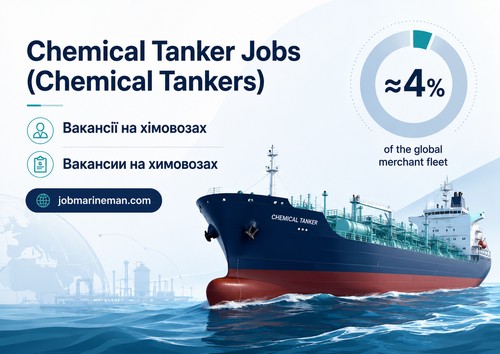
Ang trabaho sa chemical tanker ay chemistry sa literal na kahulugan: cargo compatibility, toxicity, reactivity. Maling pagkakasunod-sunod ng loading ng incompatible cargoes = chemical reaction, sunog, o toxic release.
Direct hiring mula sa shipowners nang walang intermediaries.
→ View chemical tanker jobs
Classification: IMO I, II, III
IBC Code (International Code for the Construction and Equipment of Ships Carrying Dangerous Chemicals in Bulk) hinahati ang chemical tankers sa tatlong uri ayon sa hazard level ng mga cargoes na dinadala:
IMO Type I — maximum hazard
Pinakamapanganib na cargoes: strong acids, highly toxic substances, reactive compounds. Construction: double hull, independent tanks, maximum distance mula sa side shell. Maliit ang bilang ng vessels — makitid na market, premium salaries. Karaniwang 5 000–20 000 DWT.
IMO Type II — medium hazard
Pinakamalawak na uri. Cargoes: methanol, caustic soda (NaOH), phosphoric acid, MEG (monoethylene glycol), benzene, xylene, premium-class vegetable oils. Double bottom at double sides. Vessels 10 000–45 000 DWT.
IMO Type III — low hazard
Cargoes na may minimal risk: vegetable oils, fats, molasses, ilang petroleum products. Sa construction, mas malapit sa product tankers. Madalas Combi vessels (Oil/Chemical).
Suriin ang type ng specific vessel — Global Vessel Database.
Cargo system: bakit ang chemical tanker ang pinaka-komplikadong tanker
20–40 cargoes nang sabay-sabay
Sa crude tanker — isang cargo. Sa product tanker — 3–5 grades. Sa chemical tanker — hanggang 40 iba’t ibang chemical cargoes nang sabay-sabay, bawat isa sa hiwalay na tank. Ito ang nagtatakda ng buong specificity:
Separate pipelines — bawat tank ay may sariling line. Walang mixing.
Tank coating — stainless steel (316L) para sa aggressive chemicals, epoxy coating para sa mas less aggressive cargoes, zinc silicate para sa specific cargoes. Type of coating = listahan ng permitted cargoes.
Cargo Compatibility — ang chief officer ay kailangang suriin ang compatibility chart ayon sa IBC Code bago ang bawat loading. Ang incompatible cargoes ay hindi inilalagay sa adjacent tanks.
Framo system
Sa karamihan ng modernong chemical tankers — Framo hydraulic submerged pumps: individual pump sa bawat tank na may hydraulic drive mula sa HPU (Hydraulic Power Unit). Para sa pumpmen at engineers, ang Framo experience ay isa sa pangunahing requirements sa hiring.
Cargo Changeover at Tank Cleaning
Sa pagitan ng voyages — mandatory procedure: tank washing (fresh water, hot water, chemical cleaning agents), wall wash test (laboratory analysis ng wash samples mula sa tank walls), drying. Ang wall wash result ang nagtatakda kung accepted ang tank para sa next cargo. Para sa deck crew at pumpman — daily reality ito.
Sampling at Gas Freeing
Sampling during loading/discharging at gas freeing ng tanks bago pumasok ay standard procedures na kinokontrol ng chief officer at cargo surveyor.
CDI inspections: ano ang dapat malaman ng crew
CDI (Chemical Distribution Institute) — inspection system na espesyal na ginawa para sa chemical tankers. Analog ng SIRE 2.0 para sa chemical segment. Major chemical charterers (BASF, Dow, Shell Chemicals, Exxon Chemical, Stolt Nielsen) ay nagcha-charter lamang ng vessels na nakapasa sa CDI.
Sinusuri ng inspector: cargo operations, cargo documentation, tanks at coatings, tank cleaning, gas detection, PPE, knowledge of the IBC Code.
Batay sa JobMarineMan recruitment experience, ang crew na may successful CDI inspections ay mas mataas ang value sa market — ito ay tunay na competitive advantage kapag naghahanap ng tanker fleet jobs.
Positions in demand
Deck crew
Master jobs — IBC Code, cargo compatibility, CDI. Karaniwang $10 000–16 000/month.
Chief Officer jobs — cargo planning, wall wash, sampling, compatibility chart. $7 000–11 000/month.
2/O jobs — $4 000–6 500/month.
3/O jobs — $3 500–5 500/month.
JO jobs — $3 000–4 200/month.
Pumpman — Framo, tank cleaning, cargo changeover. $2 800–3 500/month.
AB jobs — $1 800–2 500/month.
Engine crew
Chief Engineer jobs — $10 000–16 000/month.
2/E jobs — Framo HPU, separators, boilers. $6 500–10 000/month.
3/E jobs — $5 000–7 500/month.
4/E jobs — $3 800–5 800/month.
ETO jobs — Ex-proof (IECEx/ATEX), cargo monitoring, gas detection. $5 500–8 000/month.
Oiler jobs — $1 800–2 500/month.
Ang sahod sa chemical tankers ay karaniwang 10–20% mas mataas kaysa sa crude tankers at product tankers na may katulad na size.
→ Submit CV for Chemical Tanker Jobs
Documents
Standard STCW + mandatory Chemical Tanker Endorsement:
V/1-1-1 — Oil/Chemical Tanker Familiarization (para sa buong crew)
V/1-1-3 — Advanced Training for Chemical Tanker Cargo Operations (para sa officers at pumpman)
Para sa ETO — Ex-proof knowledge (IECEx/ATEX, Zone 0/1/2). Para sa engineers — Framo HPU experience ay critically important.
Sa dry cargo fleet, hindi kailangan ang endorsements. Sa gas fleet — Gas Tanker (V/1-2). Chemical Endorsement ay hiwalay sa Oil Tanker.
Largest operators
Stolt Tankers (pinakamalaki sa mundo), Odfjell, MOL Chemical Tankers, Navig8 Chemical, Team Tankers, Tokyo Marine, Ace Tankers, Jo Tankers, Iino Kaiun, Essberger.
Check — Shipowners Directory.
→ Choose a shipowner
How to get on a chemical tanker
From product tanker. Ito ang pinaka-common path. Ang officer na may Oil Tanker Endorsement ay kumukuha ng Chemical (V/1-1-3) at lumilipat. Cargo operations experience ay transferable.
From dry cargo fleet. JO o JE ay kumukuha ng Chemical Endorsement at sumasakay sa chemical tanker. Companies take juniors — may staff shortage.
Directly. Graduate with Chemical Tanker Endorsement → first contract on a chemical tanker.
💡 Tip from JobMarineMan: chemical tanker experience ay isa sa pinakamahalagang assets sa CV ng seafarer. Ang officer na may 3+ contracts sa IMO II chemical tanker at successful CDI inspections ay palaging in demand. Kapag pumipili sa pagitan ng crude at chemical — chemical tanker gives more for the career.
FAQ
What is a chemical tanker?
Chemical tanker — vessel para sa pagdadala ng dangerous chemical cargoes ayon sa IBC Code. Hanggang 40 cargoes nang sabay-sabay, stainless steel tanks, Framo system, CDI inspections. Pinaka-complex na segment ng tanker fleet.
How is a chemical tanker different from a product tanker?
Product tanker carries petroleum products (gasoline, diesel). Chemical tanker — chemical cargoes (methanol, acids, vegetable oils). Mas maraming cargoes nang sabay-sabay, stricter procedures (IBC Code, compatibility), stainless steel tanks. Salaries are 10–20% higher.
What is Framo?
Hydraulic submerged pump system — individual pump sa bawat tank. Installed sa karamihan ng chemical tankers. Framo experience ay key requirement para sa pumpmen at engineers.
What is CDI?
Chemical Distribution Institute — inspection system para sa chemical tankers. Major charterers (BASF, Dow, Shell Chemicals) charter only vessels that have passed CDI. Successful CDI inspections sa CV ay serious advantage.
What are the salaries?
10–20% higher than crude/product. AB — $1 800–2 500, 3/O — $3 500–5 500, ETO — $5 500–8 000, Master — $10 000–16 000.
Which endorsement is required?
Chemical Tanker Endorsement V/1-1-3 (Advanced). Separate from Oil Tanker (V/1-1-2). V/1-1-1 (Familiarization) — para sa buong crew.
How to apply?
CV through JobMarineMan — direct contact with the shipowner. Shipowners Directory, Global Vessel Database.
Other vessel types
Dry Cargo Fleet — Tanker Fleet — Gas Fleet — Offshore Fleet — Passenger Fleet — Yacht Sector
Maritime Mentors — Shipowners Directory — Global Vessel Database