Dry Cargo Fleet Jobs
Unfortunately, nothing was found as per your request
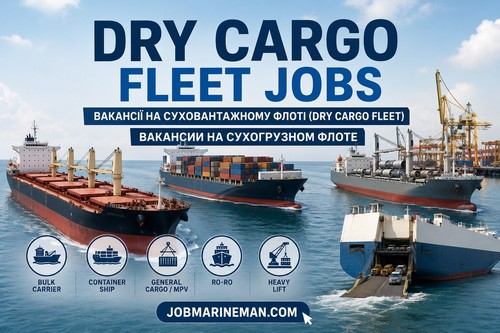
Dry Cargo Fleet: What It Is and Why It Offers the Most Jobs
The Dry Cargo Fleet consists of vessels transporting dry cargoes such as grain, coal, ore, containers, steel, timber, fertilizers, cement, vehicles and project cargo.By the number of vessels and crews, it is one of the largest segments of the global merchant fleet, offering one of the widest selections of jobs for seafarers.Unlike tanker and gas fleets, where special endorsements are required, dry cargo vessels can usually be joined with a basic set of STCW certificates. This makes dry cargo an excellent entry point for junior seafarers and a stable career platform for experienced officers and ratings.
Types of Dry Cargo Vessels
Bulk Carriers
Bulk carriers transport bulk cargoes such as grain, coal, ore, fertilizers, bauxite and cement.Main bulk carrier segments:
- Handysize — usually 15,000–35,000 DWT
- Handymax / Supramax / Ultramax — approximately 35,000–65,000 DWT
- Panamax / Kamsarmax — around 65,000–82,000 DWT
- Capesize — 100,000+ DWT
A bulk carrier crew usually consists of 20–25 seafarers. It is a classic option for a first contract: Junior Officer, Junior Engineer, OS or Wiper.
Container Ships
Container ships transport standard TEU containers. The segment ranges from small feeder vessels to mega container ships.The work environment includes high speed operations, tight port schedules, lashing/unlashing containers and large numbers of reefer sockets. Electricians and ETOs are especially востребованы on these vessels.
General Cargo / MPV
General Cargo and Multipurpose Vessels transport steel, timber, project cargo and various general cargoes. Many vessels are equipped with their own cranes.Common positions include AB/Crane Operator, AB/Cook, Cook, Fitter, Single Engineer and other combined roles.
Ro-Ro
Ro-Ro vessels transport cars, trucks, trailers and other wheeled cargo. Loading operations are carried out via ramps.Typical operations include vehicle lashing, frequent port calls and work inside enclosed cargo spaces.
Heavy Lift Vessels
Heavy Lift vessels are specialized ships equipped with powerful cranes for transporting oversized and heavy cargo such as platform modules, generators, transformers and industrial equipment.Check a Vessel in the Global Vessel Database
Most востребованные Positions on Dry Cargo Fleet
Deck Department
Master — vessel commander. Salary usually ranges from $8,000–14,000 per month.Chief Officer — cargo operations and deck department management. Average salary: $5,500–9,000.Second Officer (2/O) — navigation, charts and ECDIS. Average salary: $3,500–5,500.Third Officer (3/O) — safety equipment and GMDSS. Average salary: $2,800–4,500.Junior Officer — first officer contract. Average salary: $2,500–3,500.AB Seaman — qualified rating. Average salary: $1,200–2,200.Ordinary Seaman (OS) — entry-level deck rating. Average salary: $800–1,400.
Engine Department
Chief Engineer — head of engine department. Salary usually ranges from $8,000–14,000 per month.Second Engineer (2/E) — daily engine department management. Average salary: $5,500–8,500.Third Engineer (3/E) — main engine and fuel systems. Average salary: $4,000–6,000.Fourth Engineer (4/E) — separators, compressors and purification systems. Average salary: $3,000–5,000.Junior Engineer — first engineering officer contract. Average salary: $2,200–3,200.ETO — electrical systems, automation and navigation equipment. Average salary: $4,500–7,000.Oiler — engine room watchkeeping. Average salary: $1,400–2,200.Wiper — entry-level engine room position. Average salary: $600–1,000.View Current Seafarer Vacancies
Choosing a Shipowner: Where to Start
If you are looking for your first dry cargo contract, focus on companies with cadet programs, clear career development systems and stable rotations.Experienced seafarers should pay attention to fleet condition, contract terms, payment reliability, crew reviews and technical management standards.Choose a Shipowner in the Shipowners Directory
Advantages of Working on Dry Cargo Fleet
The dry cargo fleet offers one of the largest selections of vacancies: bulk carriers, container ships, MPV, general cargo, Ro-Ro, heavy lift and reefer vessels.No special tanker endorsements are required to enter this segment. A standard STCW package and position-related certificates are usually sufficient.Dry cargo is suitable for a first contract, sea service accumulation and future transfer to tankers, gas carriers, offshore vessels or yachts.
Who Should Choose Dry Cargo Fleet
Junior seafarers — OS, Wiper, Mess Boy and Cadet positions.Cadets and junior officers — Junior Officer, Junior Engineer, Deck Cadet and Engine Cadet positions.Experienced officers — Master, Chief Officer, Chief Engineer and Second Engineer positions.Transition specialists — seafarers planning to gain sea time before moving to tanker, gas or offshore fleets.Get Career Advice from Maritime Mentors
Documents and STCW Requirements for Dry Cargo Fleet
Typical requirements for ratings include:
- STCW Basic Safety Training VI/1
- Proficiency in Survival Craft VI/2
- Advanced Fire Fighting VI/3
- Designated Security Duties VI/6-2
- Seafarer’s Medical Certificate
AB and Oiler positions additionally require qualification certificates such as STCW II/5 for deck ratings or STCW III/5 for engine ratings.Deck officers usually require CoC STCW II/1 and above, GMDSS GOC, Radar/ARPA, ECDIS and Medical First Aid.Engine officers usually require CoC STCW III/1 and above.ETO positions require CoC STCW III/6 and, where applicable, HV Safety Certificate.
Find Dry Cargo Fleet Jobs Through JobMarineMan
JobMarineMan helps seafarers find vacancies directly from shipowners and managers without intermediaries or agency commissions.The platform includes vacancies on bulk carriers, container ships, general cargo vessels, MPV, Ro-Ro, heavy lift and other dry cargo vessel types.View All Dry Cargo Fleet VacanciesSubmit Your CV on JobMarineMan
FAQ — Frequently Asked Questions About Dry Cargo Fleet Jobs
What is the dry cargo fleet?
The dry cargo fleet includes vessels transporting dry cargoes such as bulk carriers, container ships, general cargo vessels, MPV, Ro-Ro, heavy lift and reefer vessels.
Which vessels belong to dry cargo?
Dry cargo vessels include bulk carriers, container ships, multipurpose vessels, general cargo vessels, Ro-Ro vessels, heavy lift vessels and reefer ships.
What documents are required?
Usually a standard STCW package, medical certificate and position-related documents are required. Officers additionally need appropriate CoC certificates.
Are special endorsements required?
No. Dry cargo vessels do not require Oil, Chemical or Gas Tanker Endorsements.
Is dry cargo suitable for a first contract?
Yes. It is one of the most accessible fleet segments for OS, Wiper, Cadet, Junior Officer and Junior Engineer positions.
Where can I check a vessel?
You can check vessel information in the Global Vessel Database.
Where can I check a shipowner?
Shipowners can be checked in the Shipowners Directory.
Where can I find vacancies?
Current vacancies are available on the Seafarer Vacancies page.
Other Fleet Types
Tanker Fleet
LNG/LPG Gas Fleet
Offshore Fleet
Passenger Fleet
JobMarineMan Services
Maritime Mentors
Shipowners Directory
Global Vessel Database