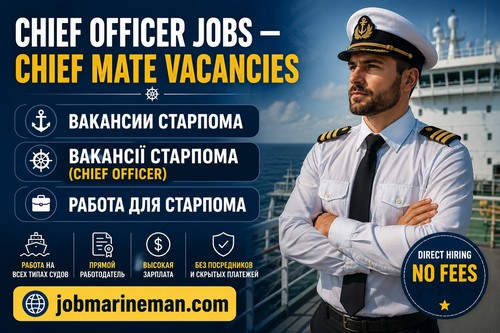
Chief Officer (Chief Mate) — A Key Role in Modern Shipping
The Chief Officer, also known as Chief Mate or First Officer, is the senior deck officer onboard and the Captain’s right hand. Responsible for cargo operations, vessel stability, deck crew management, and onboard safety, the Chief Officer plays a critical role in maintaining safe and efficient vessel operations.Today’s Chief Officers work far beyond traditional navigation duties. Modern officers manage advanced bridge systems, ballast operations, cargo planning software, Vetting inspections, and compliance with SOLAS, MARPOL, and ISM Code requirements.At JobMarineMan.com, officers can apply directly to international shipowners and Crewing Departments through a transparent Direct Hiring model without intermediaries or hidden recruitment fees.
Requirements for Chief Officer Jobs
To secure a competitive Chief Officer contract, candidates are expected to meet international fleet standards.
Core qualifications
Chief Officer Unlimited CoC;
Full STCW certification package;
Verified sea service;
Experience on a similar vessel type;
Strong knowledge of ECDIS, AIS, ARPA, and IBS;
Good Maritime English communication skills;
Knowledge of SOLAS, MARPOL, and ISM Code;
Leadership and cargo operations experience.
Tanker fleet requirements
Advanced Oil / Chemical / Gas Tanker certificates;
Vetting: Experience with SIRE 2.0 and CDI inspections;
Experience with Inert Gas Systems and Cargo Heating procedures.
SIRE 2.0 experience has become a major advantage for tanker fleet employment and international oil major approvals.
Offshore & DP requirements
Full DP Certificate;
Experience onboard PSV, AHTS, DSV, or OSV vessels;
DP operational experience.
Chief Officer Jobs by Fleet Type
Tanker Fleet — Oil, Chemical, Product & LNG
Chief Officer tanker jobs are among the highest-paying positions in the maritime industry. Officers manage cargo operations, tank cleaning procedures, inert gas systems, and strict Vetting compliance.Popular vessel types include:
Oil Tanker;
Chemical Tanker;
Product Tanker;
LNG Carrier;
LPG Carrier.
Container Ships & Bulk Carriers
Chief Officers onboard container vessels and bulk carriers supervise cargo stowage plans, lashing and securing operations, ballast control, and vessel stability during loading and discharge operations.High demand remains for:
Container Vessel;
Bulk Carrier;
General Cargo Vessel;
Multipurpose Vessel.
Heavy Lift, Ro-Ro & Car Carriers
Chief Officers on Heavy Lift and Ro-Ro vessels supervise oversized cargo operations, heavy cargo securing, ramp safety, and vehicle transportation procedures.Common vessel types include:
Heavy Lift Vessel;
Ro-Ro Vessel;
PCC / PCTC Car Carrier;
Project Cargo Vessel.
Offshore & DP Fleet
Offshore Chief Officer jobs require advanced technical knowledge and DP operational experience. Officers manage offshore cargo operations, platform supply procedures, and emergency response onboard PSV, AHTS, OSV, and DSV vessels.
Modern Technologies Used by Chief Officers
Modern Chief Officers are expected to work confidently with advanced bridge automation and digital ship systems.
Key technologies include
ECDIS & Integrated Bridge Systems;
Modern Radar & ARPA;
Load Computer Software;
Electronic Cargo Monitoring Systems;
Ballast Water Management Systems;
Starlink & satellite connectivity solutions.
Strong technical knowledge helps reduce human error, improve vessel safety, and support career progression toward Master positions.
Chief Officer Salary
Average salary ranges depend on vessel type, DWT, company, and trading area.
Bulk Carrier / General Cargo — $7,500–10,000/month;
Container Ship — $8,500–11,500/month;
Oil / Chemical Tanker — $9,500–13,000/month;
LNG Carrier — $13,000–18,000/month;
Offshore / DP Vessel — $10,000–18,000+/month.
Many shipowners additionally offer rejoining bonuses, seniority programs, and promotion opportunities toward Master positions.
How to Choose the Right Chief Officer Contract
Before applying, experienced seafarers usually evaluate:
Vessel type and trading area;
Rotation schedule and leave ratio;
Shipowner reputation and safety record;
Vessel age and technical condition;
Internet onboard availability;
PSC, Vetting, SIRE 2.0, and CDI history;
Bonus structure and employment conditions.
At JobMarineMan.com, seafarers can use the Vessel Database to check IMO details, engine type, vessel specifications, and inspection history before joining.
Why Officers Choose JobMarineMan
✅ Direct contact with shipowners and crewing departments; ✅ Chief Officer vacancies updated daily; ✅ Smart filters by DWT, salary, vessel type, and engine type; ✅ Vessel Database with IMO, PSC, and SIRE history; ✅ Telegram and WhatsApp alerts for urgent vacancies; ✅ International maritime jobs across all major fleets.
FAQ — Chief Officer Jobs
Does JobMarineMan charge recruitment fees?
No. The platform provides direct access to employers without hidden commissions or manning fees.
Can I find a Chief Officer job after a career break?
Yes. Many companies consider officers returning after a career break if they hold valid certificates and complete refresher training.
Can a Second Officer get promoted to Chief Officer?
Yes. Many shipowners actively search for experienced Second Officers ready for promotion.
What is SIRE 2.0?
SIRE 2.0 is the updated tanker inspection programme introduced by OCIMF and widely required by major tanker operators worldwide.
What salary can a Chief Officer earn on LNG vessels?
LNG Chief Officers are among the highest-paid deck officers in the industry, with salaries often exceeding $18,000/month.
Find Your Next Chief Officer Job Today
New Chief Officer vacancies are published daily on JobMarineMan.com for Tanker, LNG, Offshore, Container, Bulk Carrier, Heavy Lift, Ro-Ro, and Car Carrier fleets worldwide.Your next contract starts here.