Deck Cadet Jobs — Direct Hiring
Unfortunately, nothing was found as per your request
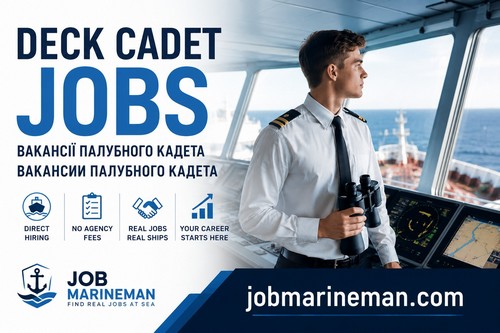
Who is a Deck Cadet and What Does a Cadet Do Onboard
A Deck Cadet works on the bridge and deck under the supervision of the Master, Chief Officer, and watchkeeping officers. The main objective is to gain practical navigational experience and complete the mandatory sea service required for government examinations and CoC issuance.
Main responsibilities include:
- Bridge Watchkeeping — navigational and port watches under officer supervision
- Navigation — working with ECDIS, RADAR, AIS, GMDSS, route planning
- Cargo Operations — ballast operations, cargo monitoring, Cargo Logbook
- Mooring & Anchoring — mooring stations and anchoring procedures
- Safety & ISM/ISPS — participation in drills and safety inspections
- Deck Maintenance — painting, chipping, and preservation work
- Training Record Book (TRB) — maintaining cadet training documentation
- Cargo Documentation — Bill of Lading, Cargo Manifest, Stowage Plan
The Training Record Book (TRB) is one of the most important cadet documents. Without a properly completed TRB, the maritime administration will not issue the OOW navigation license.
➡️ Find Deck Cadet Jobs
· Check Vessel Data via Vessel Database
· Register Your Seafarer CV
Navigation Equipment Used by Deck Cadets
Modern bridges are highly digitalized, and cadets are expected to become familiar with key navigational systems:
- ECDIS: Furuno, JRC, Sperry Marine, Raytheon Anschütz, Transas
- RADAR: Furuno FAR-series, JRC, Sperry — S-band and X-band
- GMDSS: Sailor, Furuno, JRC — DSC, EPIRB, SART, NAVTEX
- AIS, ECDIS Overlay, BNWAS
- Cargo Computers: Macgregor, LoadMaster, NAPA
- Mooring Equipment: Macgregor, Rolls-Royce winches and capstans
- Cargo Gear: cranes, grabs, ramp systems
- Lifeboats & LSA: lifeboats, life rafts, immersion suits
- Communication Systems: VHF, MF/HF, SAT-C, Inmarsat-C
Experience with specific ECDIS systems and paper chart navigation is highly valued by shipping companies.
Types of Vessels Hiring Deck Cadets
Tanker & LNG Deck Cadet Jobs
Premium segment even for cadets: higher salaries and better onboard conditions. Basic Tanker endorsement is usually required, while LNG carriers additionally require Basic LNG / IGF.
Container Vessel Deck Cadet Jobs
Fast-paced operations, short port stays, Bay Plan work, and intensive lashing operations.
➡️ Current Container Vessel Jobs
Bulk Carrier & General Cargo Cadet Jobs
Classic option for a first contract: slower operational tempo and more time for TRB completion and learning.
➡️ Latest Bulk Carrier & General Cargo Jobs
Ro-Ro & PCTC Cadet Jobs
Strong practical experience with ramps, car decks, cargo securing, and frequent mooring operations.
➡️ Current Ro-Ro / PCTC Vacancies
Cruise Ship Deck Cadet Jobs
Complex navigation, frequent maneuvering, and high English-language standards.
Deck Cadet Onboard Lifestyle
Deck Cadets usually combine bridge watchkeeping with day work duties on deck:
- At sea — bridge watch under supervision plus deck duties
- In port — assisting Chief Officer during cargo operations and documentation
- Safety drills — participation in emergency response teams
- Training — TRB completion, SMS familiarization, navigation systems practice
The standard cadet contract is usually 6 months, sometimes 4 or 8 months depending on the company.
➡️ Find Deck Cadet Jobs
· Check Vessel Data via Vessel Database
· Register Your Seafarer CV
Deck Cadet Salaries (Market Rates 2026)
Compensation depends on vessel type, company, and region:
- LNG / LPG Fleet — $800–1,500/month
- Tanker (Oil / Chemical) — $600–1,200/month
- Container ULCV — $500–1,000/month
- Cruise Ships — $500–1,000/month
- Bulk Carrier — $400–900/month
- General Cargo / Ro-Ro — $400–900/month
Some companies provide only a cadet allowance of $150–400/month but cover STCW courses, uniforms, and educational expenses.
Direct hiring through JobMarineMan focuses on companies offering fully paid cadet programs.
Qualification Requirements for Deck Cadets
To apply for Deck Cadet vacancies, candidates usually need:
- Student or graduate in Navigation / Nautical Science
- Cadet Certificate or official sea practice letter
- Training Record Book (TRB)
- Seafarer’s ID / Seaman’s Book
- STCW A-VI/1 Basic Safety Training
- ENG1 medical certificate or equivalent
- English language — Marlins 50%+
- For tanker fleet — Basic Tanker endorsement
- For LNG fleet — Basic LNG / IGF
- For premium fleets — ECDIS Generic Course preferred
Career Path After Deck Cadetship
Deck Cadet → Third Officer (3/O)
After 6–12 months of sea service, exams, and obtaining CoC II/1.
Third Officer → Second Officer (2/O)
Usually after 12–24 months of service as 3/O.
Second Officer → Chief Officer (C/O)
Typically after 24–36 months. Responsible for cargo operations, ballast management, and onboard safety.
Chief Officer → Master / Captain
Final stage of the navigation officer career path.
The complete path from Deck Cadet to Master usually takes 10–15 years.
To accelerate professional growth, connect with a Maritime Mentor through the Be Mentor Program
.
Common Mistakes That Destroy Deck Cadet CVs
Most common rejection reasons:
- Incomplete TRB
- Expired STCW certificates
- No mention of ECDIS systems
- Weak English level
- No official training endorsement from maritime academy
- Overly generic sea service description
- Missing Basic Tanker / LNG endorsements
- Expired medical or Seaman’s Book
Direct hiring through JobMarineMan helps cadets receive fast feedback from crewing departments and improve their CVs.
Why Choose Direct Hiring on JobMarineMan
The first sea contract often defines the entire future career path.
JobMarineMan helps cadets with:
- Technical Data — vessel verification through Vessel Database
- Direct Contact — communication directly with crewing managers
- No Fees — no hidden commissions or deposits
- 48-Hour Feedback — average response time for direct hiring
Frequently Asked Questions
Can I work as a Deck Cadet without maritime education?
No. Navigation / Nautical Science education is mandatory under STCW requirements.
How long does Deck Cadet sea service last?
Usually 6–12 months.
What matters more during interviews — TRB or English?
Both are critical. Without Marlins 50%+ and a properly completed TRB, employment chances are extremely low.
Which vessel type is best for a first contract?
- Bulk Carrier / General Cargo — more time for learning
- Tanker / LNG — higher salaries and higher standards
- Container Ships — intensive operational practice
- Cruise Ships — strong English and complex navigation
Do employers pay for flights and visas?
In most cases — yes.
Can cadetship be combined with maritime studies?
Yes. Sea practice is a mandatory part of maritime academy programs.
What should I do after my first cadet contract?
Pass state examinations, obtain CoC II/1, and apply for Third Officer positions.
Is an ECDIS Generic Course mandatory?
Not always, but it provides a major advantage during recruitment.
Can I transfer from Engine Cadet to Deck Cadet?
No. These are different maritime specialties with separate STCW career paths and licenses.