Deck Fitter Jobs at Sea
Unfortunately, nothing was found as per your request
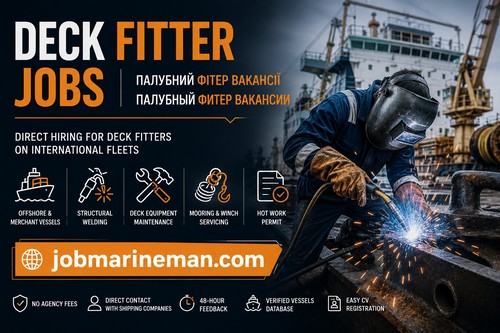
Who is a Fitter Onboard
A Fitter is a qualified rating with technical education and welding certification. Unlike Motormen or Oilers, a Fitter normally does not stand engine watches. The position is usually organized as day work under the supervision of the Chief Engineer, Second Engineer, or Chief Officer.It is one of the most demanded technical rating positions in the maritime industry. Salaries are often higher than standard engine ratings, while offshore, FPSO, LNG, and DSV sectors may offer compensation close to junior officer levels.➡️ Find Fitter Jobs at Sea
· Check Vessel Data via Vessel Database
· Register Your Seafarer CV
Engine Fitter vs Deck Fitter — What is the Difference
Engine Fitter
The most common fitter position onboard merchant vessels. Works in the engine department under the Second Engineer, with daily tasks assigned by the Third Engineer.Main duties include:
- TIG, MIG, and MMA welding on pipes and steel structures
- Lathe and milling machine operations
- Manufacturing gaskets, bushings, studs, and brackets
- Repairs of pumps, heat exchangers, and separators
- Auxiliary engine repair support
- High and low-pressure pipe repairs
- Work with cylinder liners and piston rings
- Fabrication and replacement of gratings, supports, and foundations
Deck Fitter
A more specialized offshore-oriented position commonly found on FPSO, DSV, drilling rigs, OSV, and pipe-laying vessels.Main duties include:
- Structural welding on deck and hull
- Mooring equipment and winch repairs
- Fabrication of steel foundations
- Cargo crane and ramp maintenance
- Pipe-handling and drilling support
- Hull maintenance and anti-corrosion work
- Participation in Hot Work Permit operations
On many standard cargo vessels, some Deck Fitter duties are handled by Bosun and AB crew, which is why most vacancies are for Engine Fitter positions.
Technical Responsibilities of a Fitter
Core technical skills usually include:
- TIG (GTAW), MIG/MAG (GMAW), MMA (SMAW) welding
- Gas cutting and plasma cutting
- Metal fabrication and fitting
- Pipe work installation and welding
- Lathe machine operations
- Reading technical drawings and blueprints
- Hot Work Permit compliance
- PMS documentation and maintenance reporting
Equipment and Machinery Used by Fitters
Typical onboard equipment includes:
- Welding machines: Lincoln, ESAB, Miller, Kemppi
- Gas cutting torches
- Plasma cutting systems: Hypertherm, ESAB
- Lathe machines: DMTG, Colchester, Boxford
- Milling machines: Bridgeport, JET
- Magnetic drills and power tools: Hilti, Bosch, Makita
- Rigging and lifting equipment
- NDT inspection tools: MPI, dye penetrant
Experience in stainless steel TIG welding and pipe welding significantly increases salary potential.
Vessel Types Hiring Fitters
Tanker, Chemical & LNG Fleet
High-paying segment with strong demand for certified welders. Basic Tanker endorsement is often required, while LNG fleet usually requires Basic LNG / IGF certification.➡️ Open LNG Fleet Vacancies
Container Vessels
Frequent repairs, maintenance work, and extensive auxiliary equipment systems.➡️ Current Container Vessel Jobs
Bulk Carrier & General Cargo Fleet
Classic segment for gaining pipe work and structural repair experience.➡️ Latest Bulk Carrier & General Cargo Jobs
Ro-Ro & PCTC Fleet
Large amount of hydraulic systems, ramps, and movable cargo equipment.➡️ Current Ro-Ro / PCTC Vacancies
Offshore Fleet (FPSO, DSV, Pipe-Layers)
The highest-paying sector for fitters, especially for candidates with 6G welding qualification and offshore experience.
Fitter Onboard Lifestyle
Unlike engine watchkeeping ratings, Fitters usually work as day workers:
- Standard schedule: 08:00–17:00
- Tasks assigned by 3/E or Chief Officer
- All hot work strictly controlled by Permit to Work systems
- Emergency repairs may require overtime or night work
- Standard contracts: 4±1 or 6±1 months
- Overtime usually paid separately
➡️ Find Fitter Jobs at Sea
· Check Vessel Data via Vessel Database
· Register Your Seafarer CV
Fitter Salaries (Market Rates 2026)
- Offshore (FPSO, DSV) — $2,500–4,500/month
- LNG / LPG Fleet — $2,500–3,500/month
- Tanker (Oil / Chemical) — $2,000–3,000/month
- Container ULCV — $1,800–2,500/month
- Bulk Carrier — $1,500–2,200/month
- Cruise Liners — $1,500–2,200/month
- General Cargo / Ro-Ro — $1,500–2,200/month
Qualification Requirements
Crewing departments usually expect:
- Technical school or maritime college diploma
- Welding certificate minimum 3G
- 6G qualification preferred for LNG and Offshore
- Minimum 12 months experience
- STCW A-VI/1
- Seaman’s Book and Seafarer’s ID
- ENG1 medical or equivalent
- English — Marlins 40–50%
- Basic Tanker / LNG endorsements
Lathe and milling machine experience is considered a major advantage.
Career Growth for Fitters
Typical career development paths include:
- Senior Fitter / Workshop Foreman
- Donkeyman
- Engine Cadet → 4/E → 3/E → 2/E
- Welding Inspector / NDT Specialist
- Offshore Welding Specialist
To move faster into LNG or Offshore sectors, candidates can connect with a Maritime Mentor through the Be Mentor Program
.
Common Mistakes That Destroy Fitter CVs
Most common rejection reasons:
- No valid welding certificate
- Welding processes not specified (TIG / MIG / MMA)
- No 3G / 6G qualification mentioned
- Too generic sea service description
- Missing Basic Tanker / LNG endorsements
- Expired STCW or medical certificates
- No machine shop experience
- Expired Seaman’s Book
Why Choose Direct Hiring on JobMarineMan
Fitter is one of the most demanded technical positions in modern shipping.JobMarineMan provides:
- Technical Data — vessel verification through Vessel Database
- Direct Contact — communication directly with crewing departments
- No Fees — no hidden commissions
- 48-Hour Feedback — average response time
Frequently Asked Questions
What is the difference between Engine Fitter and Deck Fitter?
Engine Fitter works in the engine department, while Deck Fitter mainly works on offshore or specialized vessels.
Is a diploma required to work as a Fitter?
Yes. Technical education and welding certification are normally required.
What welding qualification is required?
Minimum 3G. LNG and Offshore sectors often require 6G.
Does a Fitter stand engine watches?
Normally no. Most Fitter positions are organized as day work.
Can a Fitter become an officer?
Yes. Through maritime education and transition into Engine Cadet / 4/E career path.
Which sectors pay the highest salaries?
FPSO, DSV, Offshore, and LNG fleets.
Do employers pay for courses and certifications?
Often yes, especially STCW and vessel-specific endorsements.
Is English required?
Yes. Minimum Marlins 40–50% is commonly expected.
How long are contracts?
Usually 4±1 or 6±1 months.