Bulk Carrier Jobs (Bulk Carriers)
Unfortunately, nothing was found as per your request
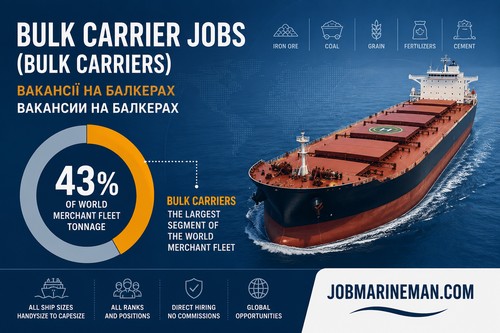
Bulk Carriers — The Backbone of Global Trade
Thousands of bulk carriers sail between Australia, Brazil, China, Europe, Africa, and the Middle East every day. Every vessel requires a qualified crew — from OS and Wiper positions to Master and Chief Engineer.
Working on a bulk carrier means:
- stable contracts;
- long ocean voyages;
- predictable working routines;
- excellent career entry opportunities;
- direct hiring without intermediaries.
View All Bulk Carrier Vacancies
What Is a Bulk Carrier
A bulk carrier (bulker, bulk vessel) is a ship designed to transport unpackaged bulk cargoes such as:
- grain;
- coal;
- iron ore;
- fertilizers;
- cement;
- bauxite;
- clinker;
- steel products.
Typical bulk carrier construction includes:
- cargo holds;
- large hatch covers;
- reinforced hull structure;
- self-trimming systems.
According to JobMarineMan recruitment experience, bulk carriers are often the first vessel type for:
- Junior Officer;
- Junior Engineer;
- OS;
- Wiper.
Why Seafarers Choose Bulk Carrier Fleet Jobs
Minimal Certification Requirements
For most bulk carrier jobs, basic STCW certificates are sufficient.
Unlike:
- tanker fleet jobs;
- LNG/LPG fleet jobs;
- passenger ship jobs.
Additional endorsements are usually not required:
- Oil Tanker Endorsement;
- Gas Tanker Endorsement;
- Crowd Management.
Stable Working Routine
Bulk carriers typically operate on long ocean passages:
- 20–45 days;
- fewer port operations;
- more time for onboard training and adaptation.
Classic Technical Experience
Most bulk carriers are equipped with:
- MAN B&W engines;
- Wärtsilä;
- Daihatsu;
- Yanmar.
This creates an excellent foundation for:
- Junior Engineer;
- 4/E;
- 3/E;
- ETO.
Bulk Carrier Classification
Handysize (15,000–35,000 DWT)
Smaller bulk carriers, often geared with onboard cranes.
Main cargoes:
- grain;
- timber;
- fertilizers;
- cement;
- steel products.
Advantages:
- more ports;
- crane operation experience;
- strong demand for AB/Crane Operator.
Disadvantages:
- older vessels;
- lower salaries.
Handymax / Supramax / Ultramax (35,000–65,000 DWT)
The most versatile segment of the bulk carrier market.
Supramax and Ultramax vessels are considered ideal for first contracts because of:
- flexibility;
- stable trading routes;
- modern equipment.
Typical engines:
- MAN B&W 6S50MC-C;
- MAN B&W 6S50ME-B;
- Wärtsilä.
Panamax / Kamsarmax (65,000–82,000 DWT)
Designed for Panama Canal transit.
Usually:
- gearless;
- operated with shore cranes;
- transporting coal, ore, and grain.
Capesize (100,000–200,000+ DWT)
The largest bulk carriers.
Main routes:
- Australia → China;
- Brazil → China.
Primary cargoes:
- iron ore;
- coal.
Advantages:
- high salaries;
- long ocean passages;
- experience on the world’s largest dry cargo vessels.
VLOC / Valemax (200,000–400,000 DWT)
Very Large Ore Carriers — the largest ore carriers in the world.
Check Vessel Specifications in Global Vessel Database
Cargoes Carried by Bulk Carriers
Iron Ore
Main cargo for Capesize and VLOC vessels.
Coal
Thermal and coking coal cargoes.
Grain
- wheat;
- corn;
- soybeans;
- barley.
Requires knowledge of:
- IMSBC Code;
- grain stability calculations.
Bauxite
A dangerous bulk cargo with liquefaction risk.
Fertilizers
- urea;
- ammonium nitrate;
- DAP;
- MOP.
Cement / Clinker
Common cargoes for Supramax and Handysize vessels.
IMSBC Code
The International Maritime Solid Bulk Cargoes Code is a mandatory IMO code regulating bulk cargo transportation.
It covers:
- cargo classification;
- moisture limits;
- ventilation requirements;
- testing procedures;
- TML;
- Flow Moisture Point.
Knowledge of the IMSBC Code is essential for:
- Chief Officer;
- Master.
Bulk Carrier Vacancies
Deck Department
- Master — $8,000–14,000;
- Chief Officer — $5,500–8,500;
- 2/O — $3,500–5,500;
- 3/O — $2,800–4,500;
- Junior Officer — $2,500–3,500;
- AB — $1,200–2,000;
- OS — $800–1,400.
Engine Department
- Chief Engineer — $8,000–14,000;
- 2/E — $5,500–8,500;
- 3/E — $4,000–6,000;
- 4/E — $3,000–5,000;
- Junior Engineer — $2,200–3,200;
- ETO — $4,500–6,500;
- Oiler — $1,400–2,000;
- Wiper — $600–1,000;
- Cook — $1,800–2,500.
Salary ranges depend on:
- Shipowner;
- vessel size;
- flag;
- trading area.
Submit CV for Bulk Carrier Jobs
Main Engines on Bulk Carriers
Most bulk carriers are powered by 2-stroke slow-speed MAN B&W engines.
Typical Models
Handysize / Supramax
- MAN B&W 6S46MC-C;
- MAN B&W 6S50MC-C.
Panamax / Kamsarmax
- MAN B&W 6S50ME-B;
- MAN B&W 6S60ME-C.
Capesize
- MAN B&W 7S65ME-C.
ME-C / ME-B series are electronically controlled engines.
RightShip
RightShip is an international ship safety and quality rating system.
A high RightShip rating:
- strengthens a seafarer’s CV;
- improves employment opportunities;
- indicates high vessel standards.
RightShip evaluates:
- hull condition;
- engine room;
- PMS;
- Oil Record Book;
- MLC 2006 compliance;
- crew safety standards.
Documents Required for Bulk Carrier Jobs
Ratings
- STCW BST;
- PSCRB;
- AFF;
- DSD.
AB
- II/5.
Oiler
- III/5.
Deck Officers
- CoC II/1+;
- GMDSS;
- Radar/ARPA;
- ECDIS.
Engine Officers
- CoC III/1+.
ETO
- CoC III/6.
Major Bulk Operators
- Pacific Basin;
- Oldendorff Carriers;
- Star Bulk;
- Golden Ocean;
- Berge Bulk;
- NYK Dry Bulk;
- MOL Drybulk;
- Polaris Shipping;
- Eagle Bulk.
Check Shipowners in Shipowners Directory
How to Choose a Bulk Carrier Vacancy
Vessel Size
- Handysize — more ports;
- Supramax — best career start;
- Capesize — higher salaries.
Geared or Gearless
- Geared — crane operation experience;
- Gearless — simpler for beginners.
Cargo Type
- grain;
- coal;
- iron ore;
- bauxite;
- clinker.
Vessel Age
A modern Ultramax and an older Handysize provide very different:
- equipment standards;
- automation levels;
- living conditions.
Check Vessel Details in Global Vessel Database
RightShip Rating
A high rating means:
- better vessel quality;
- stronger CV value.
Verify the Company
Career Guidance
Find Bulk Carrier Jobs with JobMarineMan
- Verified Shipowners;
- all bulk carrier sizes;
- all positions and ranks;
- direct hiring without commissions;
- daily vacancy updates.
FAQ
What Is a Bulk Carrier
A bulk carrier is a vessel designed to transport bulk cargoes such as:
- grain;
- coal;
- iron ore;
- fertilizers;
- cement.
What Are Bulk Carrier Salaries
- OS — $800–1,400;
- AB — $1,200–2,000;
- 3/O — $2,800–4,500;
- 2/E — $5,500–8,500;
- Master — $8,000–14,000.
Are Special Endorsements Required
No. Basic STCW certificates are usually sufficient.
Are Bulk Carriers Good for First Contracts
Yes. Especially:
- Supramax;
- Ultramax.
What Is RightShip
An international vessel safety and quality rating system.
What Is the IMSBC Code
The IMO code regulating bulk cargo transportation.
Typical Rotation Period
Usually:
- 6–9 months;
- some European companies offer 4–6 months.
What Engines Are Used on Bulk Carriers
Main engines:
- MAN B&W MC;
- MAN B&W ME.
Auxiliary engines:
- Daihatsu;
- Yanmar;
- MAN L-series.
How to Apply Quickly
Upload Your CV via JobMarineMan