LNG Carrier Jobs
Unfortunately, nothing was found as per your request
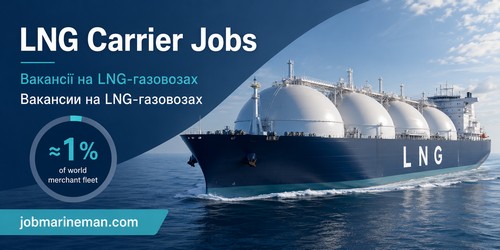
→ View LNG Carrier Jobs
Types of LNG Vessels
By Tank System
Membrane vessels (GTT — Gaztransport & Technigaz):Mark III — polyurethane insulation + stainless steel membrane (1.2 mm). The most common type on newbuilds.NO96 — plywood-perlite insulation + Invar membrane (36% Ni). Classic French technology.Both types: primary + secondary barrier, Inter-Barrier Space monitoring system (IBS). Gas Engineers and ETOs maintain gas analysis sensors in the IBS.Spherical vessels (Moss Maritime):
Recognizable domes on deck. Independent self-supporting tanks made of aluminum alloy. Support system, thermal insulation, compensation units for thermal expansion of the equatorial ring. They are built less often today, but hundreds of Moss vessels remain in operation.
By Propulsion
Steam Turbine — classic system: BOG is burned in boilers, steam → turbine → propeller. Steam Turbine Endorsement is required for engineers.DFDE (Dual-Fuel Diesel-Electric) — dual-fuel diesel generators power the electric motor (Wärtsilä 50DF). Flexibility: gas or diesel.ME-GI (MAN) — dual-fuel 2-stroke main engine, high-pressure gas injection (300 bar). Maximum efficiency.X-DF (Wärtsilä) — dual-fuel 2-stroke engine, low-pressure gas injection. Growing segment.MEGI + Reliquefaction — part of the BOG goes to the engine, part goes back into liquid form. Minimum cargo loss.
FSRU (Floating Storage and Regasification Unit)
Floating regasification is a growing segment after the 2022 energy crisis. LNG storage + vaporizers (ORV, SCV) + gas delivery to the shore network. Stationary operation, 28/28 rotation. Salaries are maximum even by LNG standards.Check the vessel — Global Vessel Database.
→ Check a vessel in Global Vessel Database
BOG Management: Key LNG Operation
BOG (Boil-Off Gas) is gas that naturally evaporates from tanks during transportation, approximately 0.08–0.15% of cargo volume per day. BOG management is the core of LNG crew operations:As fuel — BOG is directed to the engines (Steam Turbine, DFDE, ME-GI). The most efficient method.Reliquefaction — BOG is condensed back into liquid form (Hamworthy / Wärtsilä Gas Solutions, TGE Marine). Minimum cargo loss.GCU (Gas Combustion Unit) — burning excess BOG. Last option.Pressure control — tank pressure must not exceed the design limit. Incorrect BOG management = emergency release through the safety valve.The Gas Engineer and Chief Officer manage BOG together: Gas Engineer — equipment, Chief Officer — cargo care.
Gas Engineer: A Unique LNG Fleet Position
Gas Engineer (Cargo Engineer) maintains the cargo system: cargo compressors (Burckhardt Laby, Atlas Copco), cargo pumps (Svanehøj — cryogenic pumps operating at −162 °C), reliquefaction, inert gas, nitrogen generators, ESD (Emergency Shutdown), cargo circuit instrumentation and automation, spray cooling system.Salary: usually $7,000–9,500/month. On ethylene carriers and FSRUs, it can reach $10,000+.
In-Demand Positions
Deck Department
Master Jobs — BOG management, cargo care. Usually $12,000–20,000/month.Chief Officer Jobs — cargo operations, cooldown, loading/discharging. $8,000–12,000/month.2/O Jobs — $5,000–7,500/month.3/O Jobs — $4,000–6,000/month.JO Jobs — $3,500–5,000/month.AB Jobs — $2,000–2,800/month.
Engine Department
Chief Engineer Jobs — propulsion + cargo system. $12,000–20,000/month.2/E Jobs — $8,000–11,000/month.3/E Jobs — $5,500–8,000/month.4/E Jobs — $4,500–6,500/month.JE Jobs — $3,200–4,500/month.Gas Engineer — $7,000–9,500/month.ETO Jobs — HV, Ex-proof, gas detection, cargo monitoring. $5,500–8,000/month.Oiler Jobs — $2,000–2,800/month.Salaries are approximate. LNG is the highest-paid segment of merchant shipping.
→ Submit CV for LNG Carrier Jobs
Documents
Standard STCW + mandatory Gas Tanker Endorsement:V/1-2-1 — Basic Training for Liquefied Gas Tanker, for all crew members.V/1-2-2 — Advanced Training for Liquefied Gas Tanker Cargo Operations, for officers and Gas Engineers.Steam Turbine Endorsement — for engineers on steam turbine LNG carriers.HV Safety Certificate — for ETOs on vessels with HV systems.Without V/1-2, you will not be accepted on LNG. This certificate is not required for dry cargo or tanker fleet jobs.
Largest LNG Operators
Nakilat (Qatargas), NYK LNG, MOL LNG, K-Line, Teekay LNG (Seapeak), GasLog (Capital Gas), Dynagas, MISC Berhad, Knutsen OAS, Flex LNG.Check — Shipowners Directory.
→ Choose a shipowner
How to Get on LNG
From the tanker fleet. The most common path. Oil Tanker experience → Gas Tanker Endorsement (V/1-2) → LNG. Usually candidates start with LPG fully pressurized vessels, then move to LPG fully refrigerated, and then to LNG.From the dry cargo fleet. A JO or JE with V/1-2 can join LNG. Due to crew shortages, companies take juniors.Directly. A graduate with Gas Tanker Endorsement through a cadet program (Nakilat, NYK, MOL).💡 Tip from JobMarineMan: obtain V/1-2 before starting your job search — no LNG operator will consider a candidate without a ready Gas Tanker Endorsement. For engineers: always check the propulsion type (Steam / DFDE / ME-GI), as each requires different experience.
FAQ
What is an LNG Carrier?
A vessel for transporting liquefied natural gas (methane) at −162 °C. Capacity: 125,000–260,000 m³. Two tank types: membrane (GTT Mark III, NO96) and spherical (Moss). The highest salaries in merchant shipping.
What are the salaries on LNG?
The highest in the industry. AB — $2,000–2,800, 3/O — $4,000–6,000, Gas Engineer — $7,000–9,500, 2/E — $8,000–11,000, Master — $12,000–20,000.
What is BOG?
Boil-Off Gas is gas that evaporates from tanks during transportation. BOG management is a key task: direct it to engines as fuel, send it to reliquefaction back into liquid form, or burn it in the GCU. Incorrect management = cargo loss or pressure excess.
What is the difference between membrane and Moss?
Membrane (GTT): tanks are integrated into the hull, with two barriers and more efficient use of volume. Moss: independent spherical tanks with recognizable domes. Today, mainly membrane vessels are being built.
What is FSRU?
Floating Storage and Regasification Unit — floating LNG regasification. Storage + vaporizers + gas delivery to shore. Stationary operation, 28/28 rotation. Salaries are maximum even by LNG standards.
What endorsements are required?
Gas Tanker Endorsement: V/1-2-1 (Basic) for all crew, V/1-2-2 (Advanced) for officers and Gas Engineers. Steam Turbine Endorsement — for steam turbine LNG carriers.
What is the rotation?
Usually 4/4 or 5/5 months (equal time). On FSRU — 28/28 days. More stable than dry cargo or tanker fleet rotations.
How to apply?
Submit your CV through JobMarineMan — Shipowners Directory, Global Vessel Database, Maritime Mentors.
Other Vessel Types
Dry Cargo Fleet — Tanker Fleet — Gas Carrier Fleet — Offshore Fleet — Passenger Fleet — Yacht SectorMaritime Mentors — Shipowners Directory — Global Vessel Database