Fourth Engineer Jobs (4/E)
Unfortunately, nothing was found as per your request
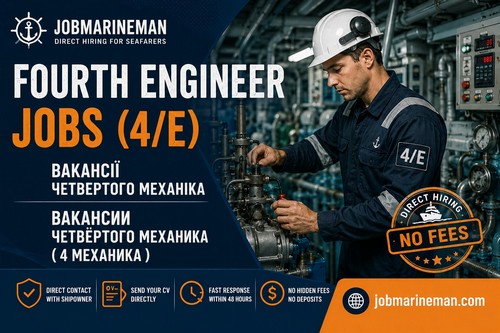
The Fourth Engineer works under the supervision of the Third Engineer and is responsible for an assigned area of the engine room while carrying out Engineering Watch duties according to STCW requirements. Main responsibilities include:
- Purifiers & Fuel Treatment — Alfa Laval / Westfalia fuel and oil separators, filters, water separators (main responsibility area of the 4/E)
- Bunkering Operations — participation in bunkering operations, level monitoring, measurements, and bunkering documentation
- Fuel & Lubrication Systems — fuel and lubrication systems, pipelines, pumps, and filters
- Sewage Treatment Plant & OWS — sewage treatment plants, oily water separators, and incinerators
- PMS Tasks — Planned Maintenance System tasks within assigned responsibility areas
- Storekeeping — spare parts and engine room inventory management
- Watchkeeping — engine room watchkeeping under the general supervision of the 2/E and 3/E
What Types of Vessels Hire Fourth Engineers
Tankers, Chemical Tankers & LNG Carriers
A strong starting point for an officer career with increased salary potential. Basic Tanker certificates are required, while gas carriers additionally require Basic LNG / IGF Code certification. Compliance with SIRE 2.0 standards is important for tanker fleets.
Open LNG fleet vacancies
Container Vessels
A good training environment for junior officers with extensive auxiliary equipment and reefer systems onboard large vessels.
Current container vessel vacancies
Bulk Carriers & General Cargo
A classic choice for a first contract as 4/E — balanced schedules, clear procedures, and the opportunity to gain sea service experience without excessive workload.
Latest Bulk Carrier & General Cargo vacancies
Ro-Ro & PCTC (Car Carriers)
Extensive hydraulic systems, ventilation systems, and auxiliary equipment provide excellent experience for junior officers.
Current Ro-Ro / PCTC vacancies
Cruise Ships & Passenger Fleet
In addition to auxiliary systems — HVAC, water treatment, and sewage systems. Contracts are usually around 4±1 months with comfortable onboard accommodation.
Equipment Operated by a Fourth Engineer
Technical experience that helps Fourth Engineers grow faster in their careers:
- Separators: Alfa Laval (S-series, P-series, MOPX), Westfalia / GEA — main responsibility area
- OWS (Oily Water Separator): RWO, Victor Marine, Marinfloc
- Sewage Treatment: Hamworthy, Taiko, Jowa, Evac
- Incinerators: Atlas, TeamTec, Saacke
- Boilers (auxiliary support): Aalborg, Miura, Kangrim
- Pumps & Compressors: Allweiler, Imo, Hatlapa, Sperre
- Bunkering Equipment: mass flow meters, measuring systems, bunkering stations
Experience with Alfa Laval / Westfalia separators is a key advantage for 4/E candidates because it is their primary responsibility area.
Fourth Engineer Salaries by Fleet Type (Market Rates)
Compensation depends on vessel type, flag, company, and candidate experience:
- LNG / LPG Fleet — $5,500–7,500/month (Basic LNG / IGF endorsements required)
- Tanker (Oil / Chemical) — $4,500–6,500/month (SIRE 2.0 / OCIMF compliance)
- Container ULCV — $4,000–5,500/month
- Bulk Carrier — $3,500–4,800/month
- Cruise Fleet — $3,500–5,000/month
- General Cargo / Ro-Ro — $3,500–4,800/month
Standard contracts are usually 4±1 or 6±1 months. Additional benefits may include overtime payments, reimbursement of professional courses, and loyalty bonuses.
Qualification Requirements
Technical Superintendents usually expect candidates to have:
- CoC Officer in Charge of an Engineering Watch (STCW Reg. III/1)
- All mandatory STCW courses in valid status
- Basic High Voltage certificate — increasingly mandatory on modern fleets
- English proficiency — Marlins / CES 50–60%+ (Operational Level)
- Sea Service — minimum 6–12 months as Engine Cadet or Wiper
- Vessel-specific endorsements (Basic Tanker, Basic LNG / IGF)
Career Path of a Fourth Engineer
Engine Cadet → Fourth Engineer
Minimum 6–12 months of sea service as a cadet, completed maritime administration exams, and a valid CoC III/1 certificate are required.
Fourth Engineer → Third Engineer
Usually requires 12–18 months of experience as 4/E on quality vessels, confident knowledge of separators, bunkering operations, and auxiliary systems.
Open Third Engineer vacancies
Next Step — Second Engineer & Chief Engineer
To understand long-term career progression, review:
Second Engineer vacancies
Chief Engineer vacancies
To accelerate promotion from 4/E to 3/E, candidates can work with a Maritime Mentor through the Be Mentor program
.
Why Choose Direct Hiring with JobMarineMan
The first officer contract is the most important stage of an engineering career. The platform provides junior engineers with:
- Technical Data — vessel verification through Vessel Database
by IMO: main engine type, PSC history, fleet age - Direct Contact — direct communication with Technical Superintendent without intermediaries
- No Fees — no hidden agency commissions or deposits
- 48-Hour Feedback — average response time with direct hiring
Frequently Asked Questions
Can I become a 4/E immediately after cadet practice?
Yes. This is the standard path: after 6–12 months of cadet sea service and obtaining CoC III/1 certification, candidates can apply for 4/E positions. Large modern fleets (LNG, ULCV, cruise ships) usually additionally require around 6 months of extra sea service.
What is the difference between 4/E and 3/E?
Formally, both positions use the same CoC III/1 certificate. The difference is responsibility and experience: the 4/E handles separators, bunkering operations, and treatment systems, while the 3/E manages auxiliary engines, boilers, compressors, and supervises the 4/E. The salary of a 3/E is usually 25–40% higher.
Is High Voltage certification required for Fourth Engineers?
On most conventional vessels it is preferred but not mandatory. On container vessels above 10,000 TEU, LNG carriers, and modern cruise ships, Basic HV certification is becoming standard.
How long should a 4/E work before promotion to 3/E?
On average, 12–18 months of sea service on quality vessels. Much depends on the shipping company — some companies promote faster if an open position exists within their own fleet.
Does the employer pay for travel and certificates?
In the vast majority of cases — yes. Flights, transfers, visas, and vessel-specific endorsements are normally covered by the employer. This is standard practice in the direct hiring market.