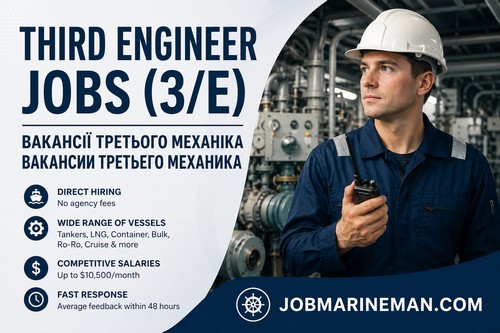
The Third Engineer reports to the Second Engineer and is responsible for a designated area of the engine room while standing Engineering Watch duties. Main responsibilities include:
Purifiers & Fuel Treatment — Alfa Laval / Westfalia fuel and oil separators, filters, bunkering operations
Boilers & Steam Systems — maintenance of auxiliary and exhaust gas boilers
Air Compressors & Starting Air — starting air and service air compressors
Fresh Water Generator — freshwater generators and ion exchange systems
PMS Tasks — Planned Maintenance System tasks within assigned responsibility area
Watchkeeping — engine room watchkeeping in accordance with STCW requirements
What Vessel Types Hire Third Engineers
Tankers, Chemical Tankers & LNG Carriers
One of the highest-paying sectors even at operational level. Basic Tanker certificates are required, while gas carriers additionally require Basic LNG / IGF Code certification. Compliance with SIRE 2.0 standards is essential for tanker fleets. Open LNG fleet vacancies
In addition to auxiliary systems — HVAC, water treatment, and sewage systems. Contracts are usually shorter, around 4±1 months, with comfortable onboard accommodation.
Engines & Equipment Operated by Third Engineers
Technical experience highly valued for Third Engineers includes:
Minimum 12 months of sea service, completed maritime administration exams, and valid CoC III/1 certification.
Third Engineer → Second Engineer
Usually requires 12–24 months as 3/E on quality vessels, upgraded CoC III/2 certification, and Advanced HV course completion. Open Second Engineer vacancies
Third Engineer is the first officer-level engineering position, and choosing the right vessel matters. The platform provides:
Technical Data — vessel verification through Vessel Database by IMO: main engine type, PSC history, fleet age
Direct Contact — communication directly with Technical Superintendent regarding onboard equipment specifics
No Fees — no hidden agency commissions or deposits
48-Hour Feedback — average response time with direct hiring
Frequently Asked Questions
Can I become a 3/E immediately after cadet practice?
Yes, if you hold a valid CoC III/1 and at least 12 months of sea service as Engine Cadet. Large modern fleets (LNG, ULCV) usually additionally require previous 4/E experience.
Is High Voltage certification required for Third Engineers?
Basic HV is increasingly mandatory — especially on container vessels above 10,000 TEU, LNG carriers, and cruise ships. For classic bulk carriers and General Cargo fleets, it is preferred but not always mandatory.
How quickly do companies respond to applications?
With direct hiring through JobMarineMan , the average Technical Superintendent feedback time is approximately 48 hours.
How long should a 3/E work before promotion to 2/E?
Formally — 12 months of sea service and successful exams. In practice, most companies prefer candidates with 18–24 months of experience on quality vessels.
Does the employer pay for travel and certificates?
In most cases — yes. Flights, transfers, visas, and vessel-specific endorsements are typically covered by the employer. This is standard practice in direct hiring.