Engine Cadet Jobs
Unfortunately, nothing was found as per your request
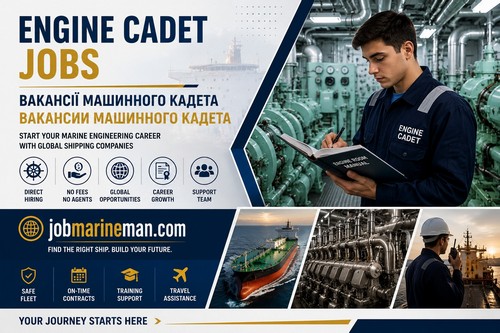
Who Is an Engine Cadet and What Are the Responsibilities Onboard
An Engine Cadet works in the engine department under the supervision of the Fourth Engineer, Third Engineer, and Chief Engineer. The main goal is to gain practical engineering experience onboard and complete the required sea service for future certification exams.
Main Duties of an Engine Cadet
- Engine Room Familiarization — learning engine room layout and ship systems
- Auxiliary Engines — assisting with maintenance of diesel generators
- Purifiers & Fuel Treatment — working with Alfa Laval / Westfalia separators
- Watchkeeping — engine room watchkeeping under supervision
- PMS Tasks — completing Planned Maintenance System tasks
- Storekeeping — inventory and spare parts management
- Bunkering Operations — assisting during bunkering operations
- Engine Logbook — maintaining engine room logbook records
- Training Record Book (TRB) — completing cadet training records
- ISM Familiarization — understanding SMS and safety procedures
The TRB is one of the most important documents for an Engine Cadet. Without a properly completed Training Record Book, maritime administrations will not issue a Fourth Engineer license.
Equipment and Systems Engine Cadets Work With
Modern engine rooms include hundreds of systems and equipment units. During cadetship, future engineers must learn the basic operating principles of:
Main Engines
- MAN B&W (ME-C, ME-GI)
- Wärtsilä (RT-flex, X-DF)
- WinGD
- Sulzer
- Mitsubishi UE
Auxiliary Equipment
- MAN L+V, Wärtsilä Auxpac, Hyundai Himsen diesel generators
- Alfa Laval and Westfalia separators
- Aalborg, Miura, Kangrim boilers
- Sperre, Hatlapa, Sauer compressors
- Alfa Laval AQUA and Atlas freshwater generators
- Imo, Allweiler, Hamworthy pumps
- OWS and Sewage Treatment systems: RWO, Taiko, Jowa, Evac
- PMS software: AMOS, ShipManager, NS5
Cadets are not expected to become experts immediately — understanding basic principles and learning how to read engine room diagrams is the key objective.
Types of Vessels Hiring Engine Cadets
Engine Cadet Tanker / LNG Fleet
Tankers and LNG carriers offer higher salaries and modern fleets. Basic Tanker certificates or Basic LNG / IGF Code endorsements are often required.
Container Ship Engine Cadet
Container vessels are an excellent school for learning powerful main engines and complex auxiliary systems.
Current Container Ship Vacancies
Bulk Carrier Engine Cadet
Bulk carriers and General Cargo ships are a classic choice for the first contract due to a calmer operational pace.
Bulk Carrier & General Cargo Vacancies
Ro-Ro / PCTC Fleet
Experience with hydraulic systems, ramp equipment, and cargo deck ventilation systems.
Cruise Vessel Engine Cadet
Cruise fleets provide experience with advanced automation systems, pod propulsion, and modern engine room technology.
Life Onboard as an Engine Cadet
Engine Cadets usually work in a mixed schedule:
- Engine room watchkeeping at sea
- Day work with engineers
- Assisting during repairs and bunkering in port
- Participating in emergency drills
- Working with TRB and technical documentation
- Typical contracts range from 4 to 8 months
➡️ Find Engine Cadet Jobs
· Check Vessel Details via Vessel Database
· Register Your Cadet CV
Engine Cadet Salaries (Market Rates 2026)
- LNG / LPG Fleet — $800–1,500/month
- Tanker Fleet — $600–1,200/month
- Container Fleet — $500–1,000/month
- Cruise Fleet — $500–1,000/month
- Bulk Carrier Fleet — $400–900/month
- General Cargo / Ro-Ro — $400–900/month
Some companies additionally cover STCW courses, uniforms, visas, and airfare.
Requirements for Engine Cadet Positions
Typical requirements include:
- Marine Engineering education or cadetship program
- Cadet Letter / internship assignment
- Training Record Book (TRB)
- Seaman’s Book
- Seafarer’s ID
- STCW Basic Safety Training (A-VI/1)
- ENG1 medical certificate or equivalent
- English language skills (Marlins 50%+)
- Basic Tanker certificate for tanker fleet
- Basic LNG / IGF endorsements for LNG fleet
Career Progression for Engine Cadets
Engine Cadet → Fourth Engineer (4/E)
After obtaining sea service and CoC III/1 certification.
Fourth Engineer → Third Engineer (3/E)
The next career stage after gaining experience as 4/E.
Third Engineer → Second Engineer (2/E)
After obtaining CoC III/2 certification.
Second Engineer → Chief Engineer
The highest engineering officer position onboard.
The full career path from Engine Cadet to Chief Engineer typically takes 8–12 years.
Common Mistakes That Prevent Engine Cadets From Getting Hired
- Incomplete or poorly maintained TRB
- Expired STCW certificates
- Weak English communication skills
- No mention of engines or equipment in CV
- Expired medical certificate
- Missing Tanker or LNG endorsements
- Generic sea service descriptions without vessel details
Direct hiring through JobMarineMan helps cadets receive faster feedback from crewing managers and improve their CVs.
Why Choose Direct Hiring Through JobMarineMan
Vessel Technical Data
Check vessel details through the Vessel Database: engine type, PSC history, flag, and vessel age.
Check Vessel Details via Vessel Database
Direct Contact
Communicate directly with crewing managers without intermediaries.
No Fees
No agency commissions or hidden recruitment charges.
Fast Feedback
Average response time is around 48 hours.
Frequently Asked Questions
Can I become an Engine Cadet without maritime education?
No. Professional maritime education is required for cadetship positions.
How long does cadet sea service last?
Usually between 6 and 12 months.
What is more important — English or TRB?
Both are critically important for securing the first contract.
Does the company pay for flights and visas?
In most cases — yes.
Which vessel type is best for the first contract?
- For learning — Bulk Carrier / General Cargo
- For higher salaries — Tanker / LNG
- For modern technology — Cruise Fleet
What should I do after my first contract?
Pass state examinations, obtain CoC III/1 certification, and apply for Fourth Engineer positions.
➡️ Find Engine Cadet Vacancies
· Create Seafarer CV
· Explore Vessel Database