Ro-Ro Cargo Ship Jobs
Unfortunately, nothing was found as per your request
→ View Ro-Ro Ship Jobs
Types of Ro-Ro Cargo
Pure Ro-Ro (Cargo Only)
Cargo vessels without passengers. Cargo carried: trailers, semi-trailers, Mafi trailers (low-bed platforms for heavy cargo), construction machinery, military cargo. Loading: stern ramp, sometimes side ramp or angular ramp.
Routes: Europe ↔ Europe (short-sea), Europe ↔ Africa, Europe ↔ Middle East, North America ↔ Europe. Crew — 18–24 people.
Companies: CLdN, Stena RoRo, UECC, Cobelfret, Seatruck Ferries, Neptune Lines.
ConRo (Container + Ro-Ro)
Combined vessels: lower decks — Ro-Ro (trailers, machinery), upper deck — containers (by cranes or STS). Maximum flexibility.
Routes: Europe ↔ West Africa (Grimaldi — the largest operator), Mediterranean, Caribbean. Crew — 20–26 people.
Companies: Grimaldi Lines, Messina, ACL (Atlantic Container Line).
Ro-Lo (Ro-Ro + Lift-on/Lift-off)
Vessels with a ramp + own cranes. Cargo carried: trailers + breakbulk + project cargo. Close to MPV, but with a ramp for wheeled cargo.
Short-Sea Ro-Ro (European Shuttle)
Small Ro-Ro vessels for short European routes: United Kingdom ↔ Ireland, United Kingdom ↔ Benelux, Baltic Sea. Voyage — 12–36 hours, 2–3 port calls per week. Rotation — 2–4 weeks (the shortest in the cargo fleet). Crew — 14–20 people.
Companies: Stena RoRo, Seatruck, CLdN, Cobelfret.
Check a vessel — Global Vessel Database.
Specifics of Working on Ro-Ro
Ramps and Cargo Operations
Loading/discharging through the stern ramp is the main operation. The Chief Officer manages: arrangement of trailers on decks (stowage plan), stability control (each trailer has a different weight), and lashing inspection.
AB and OS work on deck: direct drivers, secure trailers (chains, webbing lashings, wheel chocks), and check the reliability of securing before departure.
Turnaround speed is a key KPI: Ro-Ro stays in port for 4–8 hours (vs container ship 12–36 hours, bulk carrier 2–5 days). Every minute of delay = loss for the operator.
Lashing of Trailers and Machinery
Each trailer/semi-trailer is secured with:Chains + turnbuckles — for heavy trailers
Webbing lashings — for light machinery
Wheel chocks — wheel stoppers
Twist locks — for containers on chassis (cassettes)On Ro-Ro, lashing is simpler than on PCTC (fewer units, but each is heavier). CSS Code and Cargo Securing Manual are mandatory.
Ventilation and Fire Safety
Closed cargo decks with diesel trailers — fuel vapors + exhaust gases during loading. Powerful ventilation, drencher system, CO₂. For ETO and engineers — maintenance of fire detection and drencher systems is critical.
Ramp Maintenance
Hydraulic ramps (stern, side, internal) are under the responsibility of 3/E or 4/E. Hydraulic power units, cylinders, valves, seals — regular maintenance. On older vessels — frequent repairs.
In-Demand Positions
Deck Team
Master jobs — maneuvering, frequent mooring operations. $8,000–13,000/month.
Chief Officer jobs — stowage plan, stability, ramp operations. $5,500–8,500/month.
2/O jobs — navigation, short-sea routes. $3,500–5,500/month.
3/O jobs — safety, fire systems. $2,800–4,500/month.
AB jobs — lashing, ramps, mooring. $1,500–2,300/month.
OS jobs — $900–1,500/month.
Engine Team
Chief Engineer jobs — $8,000–13,000/month.
2/E jobs — $5,500–8,500/month.
3/E jobs — ramps (hydraulics), ventilation. $4,000–6,000/month.
4/E jobs — $3,000–5,000/month.
ETO jobs — fire detection, drencher, cargo deck lighting. $4,500–6,500/month.
Oiler jobs — $1,400–2,000/month.
Cook jobs — $1,800–2,500/month.Salaries are estimated. European short-sea operators often pay in euros according to EU standards — it may be significantly higher.
→ Submit CV for Ro-Ro Jobs
Advantages of Ro-Ro
Short voyages. Short-sea Ro-Ro: voyage 12–36 hours, 2–3 port calls per week. No ocean crossings of 30 days.
Short rotations. European short-sea: 2–4 weeks. ConRo and deep-sea: 2–4 months. Significantly shorter than bulk carriers (6–9 months).
European fleet. Most Ro-Ro operators are European companies with EU standards: salaries in euros, good conditions, stable schedules.
Navigation practice. Frequent maneuvers, mooring operations, narrow passages — for Junior Officer and 2/O — maximum navigation experience in minimum time.
No endorsements required. Basic STCW.
Documents
Standard STCW — endorsements are not required (dry cargo fleet). Knowledge of CSS Code (cargo securing) is an advantage. For European short-sea — Schengen visa or EU passport.
Largest Ro-Ro Operators
Grimaldi Group (largest, ConRo), CLdN (Europe–UK), Stena RoRo, Wallenius Wilhelmsen (also PCTC), UECC, Seatruck Ferries, Cobelfret, ACL (Atlantic Container Line), Neptune Lines, Messina.
Check — Shipowners Directory.
→ Choose a shipowner
Ro-Ro vs PCTC: What Is the Difference
PCTC — new cars (4,000–8,000 units), 12–14 decks, lashing with straps. Deep-sea routes: Japan → Europe.
Ro-Ro Cargo — trailers, semi-trailers, heavy machinery, containers on chassis. 2–6 decks, lashing with chains. Short-sea + deep-sea.On PCTC, lashing is lighter (straps), but there are more units. On Ro-Ro — fewer units, but each is heavier (chains + turnbuckles). Salaries are comparable.
FAQ
What is a Ro-Ro Cargo Ship?
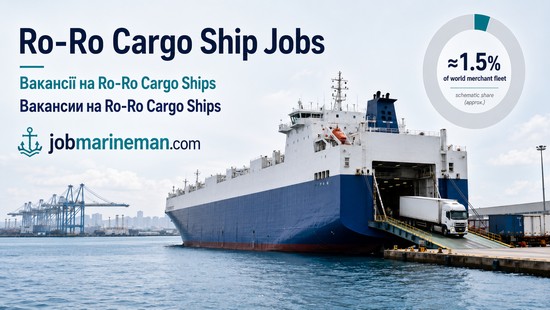
Roll-on/Roll-off is a vessel for transporting wheeled cargo via ramp: trailers, semi-trailers, Mafi trailers, construction machinery, containers on chassis. Loading is performed by driving the cargo on board, without cranes.
How is Ro-Ro different from PCTC?
PCTC — new cars (12–14 decks). Ro-Ro Cargo — commercial trailers and machinery (2–6 decks). PCTC — deep-sea. Ro-Ro — often short-sea (Europe).
What is ConRo?
Container + Ro-Ro: lower decks for trailers, upper deck for containers. The largest operator is Grimaldi.
What are the salaries?
AB — $1,500–2,300, 3/O — $2,800–4,500, ETO — $4,500–6,500, Master — $8,000–13,000. EU short-sea — often in euros, may be higher.
What is the rotation?
Short-sea (Europe): 2–4 weeks. ConRo / deep-sea: 2–4 months. One of the shortest rotations in the dry cargo fleet.
Are endorsements required?
No — basic STCW. For European routes — Schengen visa.
How to apply?
CV via JobMarineMan — Shipowners Directory, Global Vessel Database, Maritime Mentors.
Other Vessel Types
Dry Cargo Fleet — Tanker Fleet — Gas Fleet — Offshore Fleet — Passenger Fleet — Yacht Sector
Maritime Mentors — Shipowners Directory — Global Vessel Database